

Sinusitis VA ratings are based on something most veterans are never clearly told.
It is not just about having the condition. It comes down to how often your symptoms happen, how severe they are, and what kind of treatment you actually need.
The VA looks closely at things like documented episodes, antibiotic use, and whether you have had sinus surgery.
This is where a lot of claims fall apart. In this guide, I will break down how sinusitis is really rated, what the VA focuses on, and why veterans often get underrated or denied even when their symptoms are serious.
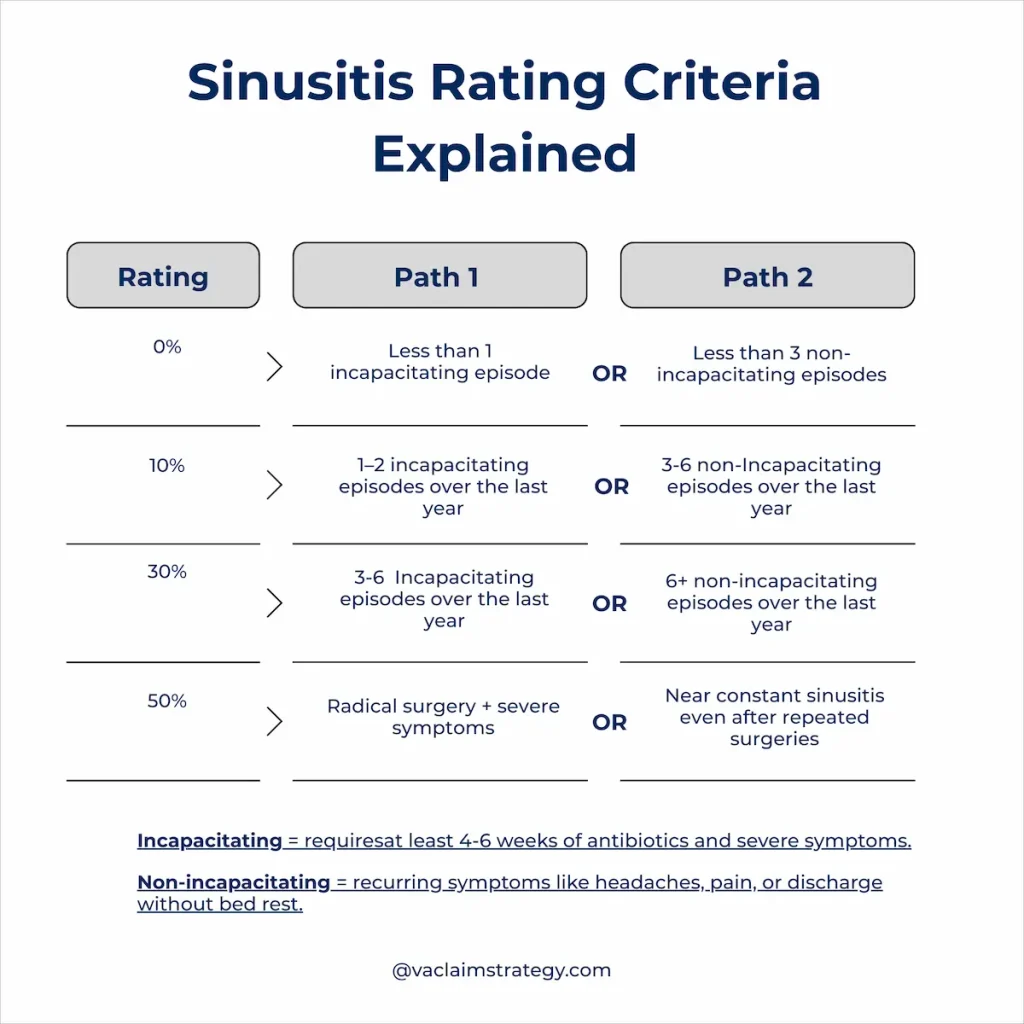
Sinusitis VA Ratings: 0%, 10%, 30%, and 50%
The VA uses the rating schedule (38 CFR § 4.97) to rate sinusitis at 0%, 10%, 30%, or 50%.
Your rating mainly depends on how many sinusitis episodes you have each year and whether those episodes are incapacitating or non-incapacitating.
0% Rating: Service-Connected but No Compensation
A 0% rating means the VA agrees that your sinusitis is connected to your service, but your symptoms do not meet the minimum level for a compensable rating.
Because the VA looks at the amount of sinus infection episodes per year, some veterans are rated at 0% even though they have really bad symptoms.
10% Rating: Limited Annual Episodes
A 10% rating is given if you meet one of the two criteria:
- One to two incapacitating episodes per year that require prolonged antibiotic treatment for four to six weeks, or
- Three to six non-incapacitating episodes per year that include headaches, sinus pain, purulent discharge, and crusting.
30% Rating: Frequent or Severe Episodes
A 30% rating is assigned if you meet one of the two criteria:
- Three or more incapacitating episodes per year requiring prolonged antibiotic treatment lasting four to six weeks, or
- More than six non-incapacitating episodes per year that include headaches, sinus pain, purulent discharge, and crusting.
50% Rating: Constant Symptoms or Post-Surgery Cases
A 50% rating is the highest rating for sinusitis.
To qualify for a 50% rating, a veteran must meet one of the two criteria:
- Radical sinus surgery followed by chronic osteomyelitis, or
- Near-constant sinusitis with headaches, pain, tenderness of the affected sinus, and purulent discharge or crusting after repeated surgeries
One important thing to note is that some veterans are granted 50% ratings even though they never had a sinus related surgery. The VA mainl
This is usually very difficult to do and requires extensive evidence showing you constantly had severe symptoms consistently.
How the VA Defines Sinus Infection Episodes
The VA looks at the chronic pattern of your symptoms over time, not just how many episodes you report or whether you had surgery. Make sure your medical records clearly show the frequency and severity of your symptoms.
What the VA Counts as a Sinusitis Episode
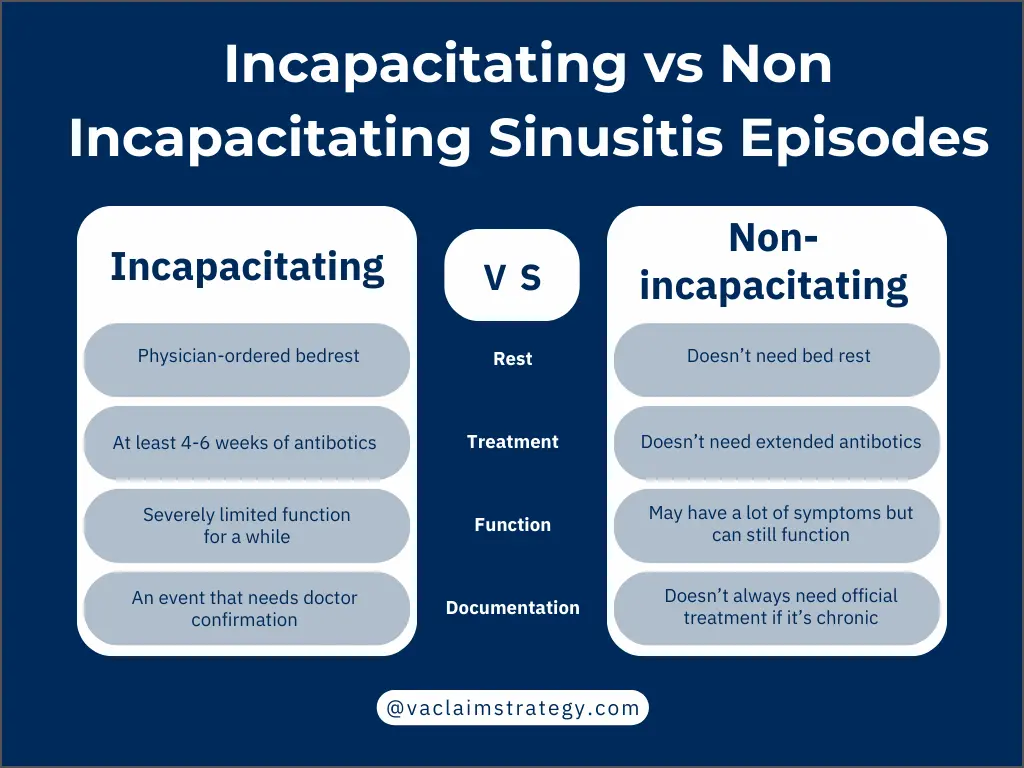
The VA separates sinusitis flare-ups into two types. Incapacitating episodes require bed rest and 4–6 weeks of antibiotics.
Non-incapacitating episodes involve symptoms like headaches, facial pain, discharge, or crusting, but the veteran can still function day to day.
Incapacitating Episodes (Strict Requirements)
This type of sinus infection usually involves severe symptoms that make it hard to function normally.
The VA is fairly strict about what counts as an incapacitating episode. In most cases, the record must show all three of the following:
- Treatment from a physician
- Bed rest ordered by a doctor
- Antibiotics lasting 4 to 6 weeks
If any of these are missing, the VA usually will not count the infection as incapacitating.
For example, if antibiotics were only prescribed for a week or two, or if a doctor never ordered bed rest, the VA will often classify the infection as a non-incapacitating.
Non-Incapacitating Episodes (More Common)
These are sinus infections with symptoms like headaches, facial pain, purulent discharge, or crusting, but the veteran is still able to function day to day.
In general, the VA is less strict when evaluating non-incapacitating episodes and often does not require the exact number of episodes to be documented.
Veterans can still qualify for up to 30% if the overall record shows severe symptoms, consistent medication use, and ongoing treatment.
Why Sinusitis Claims Get Denied
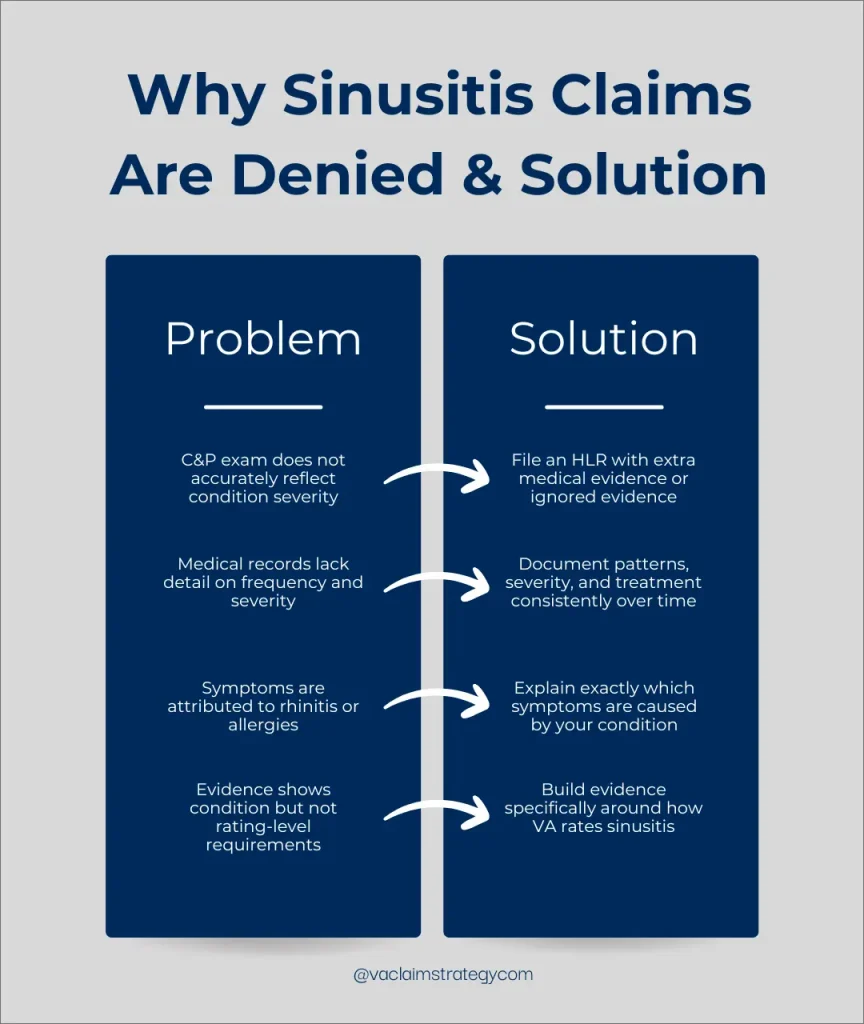
Many sinusitis claims are not denied the VA doubts the severity of your sinusitis condition.
It’s usually because of a negative C&P exam or because their medical records do not clearly document episodes, symptoms, frequency, and treatment in a way that matches the rating criteria.
Negative or Incomplete C&P Exam
Sinusitis is known for problematic C&P exams, and often it is not the veteran’s fault. Examiners are not usually focused on how severe or constant the symptoms are.
Instead, they are trying to determine whether your episodes are different than your normal everyday symptoms.
This creates a disconnect. A veteran may have daily facial pain, congestion, headaches, drainage, and repeated treatment, but the examiner may still report “0 non-incapacitating episodes.”
The examiner may mistakenly view those symptoms as “normal” for the veteran’s condition rather than separate sinus infections.
Later in the article, I will show you ways to reduce the chances of this happening.
Weak or Missing Medical Evidence
Your medical records and documentation of your sinusitis episodes is one of the most important parts of getting a sinusitis rating.
The VA is not just looking for proof that you have sinusitis. They want records that clearly describe:
- what symptoms occurred
- how often they occurred
- how severe they were
- what treatment was required
Many veterans only submit records that mention things like “sinus congestion” or “chronic sinus issues.” The VA gives very little value to these and will usually just rely on the C&P exam to determine the rating.
Symptoms Blamed on Another Condition
This happens frequently when a veteran has another service connection condition with similar symptoms.
The most common overlaps involve:
- migraines
- rhinitis
- allergies
For example, a veteran may report headaches, facial pressure, drainage, and nasal blockage.
The VA may deny a higher rating and claim that some of those symptoms are caused by migraines or rhinitis instead of sinusitis.
Evidence Does Not Meet Rating Criteria
This is way more common than many you would expect. Some claims are denied simply because the evidence proves part of the rating criteria but not all of it.
Common examples include:
- Documenting the wrong number of non-incapacitating episodes. Many veterans apply for a high rating but the records don’t support it.
- Missing required symptoms. Some veterans describe sinus infections but do not document symptoms like headaches, pain, discharge, or crusting.
- Improper documentation of incapacitating episodes. The record may mention antibiotics but not the required duration or physician involvement.
- Evidence that does not match the 50% criteria closely enough.
Make sure your records clearly show the number of episodes, the symptoms involved, and the treatment required before submitting your claim.
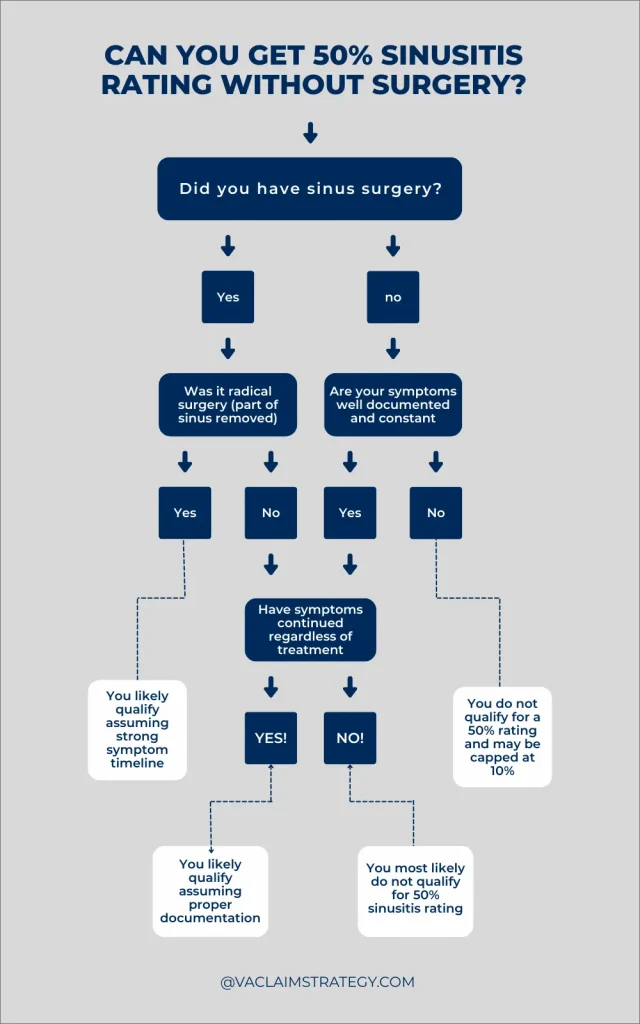
Can You Get 50% Without Sinus Surgery?
While surgery is not an absolute requirement for a 50% sinusitis rating, most veterans who are approved at this level have undergone some type of sinus surgery.
What really matters is not just whether you had surgery, but whether your records clearly show that your condition is chronic, severe, and affecting you on a near-daily basis.
What 100 VA Cases Show
Looking at a large sample of Board of Veterans’ Appeals decisions, a clear pattern shows up:
- About 78% of veterans at the 50% level had some form of sinus-related surgery
- This does not always mean major or “radical” surgery
Common examples include:
- Endoscopic sinus surgery
- Balloon sinuplasty
- Procedures to remove blockages or improve drainage
Surgery helps because it signals to the VA that your condition was serious enough to require medical intervention. It shows that basic treatments were not enough and that your sinusitis has been persistent over time.
How Veterans Qualify Without Surgery
It is still possible to reach 50% without surgery, but the bar is higher.
Without that surgical history, you need to make your case through strong, consistent evidence of how severe your condition is.
That usually means:
- Detailed treatment records showing ongoing issues
- Repeated infections or flare-ups over time
- Documentation of symptoms that do not improve with treatment
One of the most helpful things you can do is keep a consistent symptom log.
If you can clearly show that your sinusitis affects you day after day, it becomes much easier for the VA to understand the true impact of your condition. Over time, that kind of documentation can carry a lot of weight, especially when it lines up with your medical records.
What Happens at a Sinusitis C&P Exam
Veterans often have completely different experiences at sinusitis C&P exams. Regardless of who examines you, you want to answer questions as precisely as possible and focus only on what they ask.
What the Examiner Is Looking For
C&P examiners are there to answer very specific questions that tie directly to your rating.
They are not there to hear your full story or decide how much you are struggling. Their job is to gather clear, simple information as efficiently as possible.
Some of the questions you will likely get:
- Have you had surgery? This is mainly used to see if you qualify for higher ratings, especially 50%.
- What symptoms have you had? This helps them determine if your symptoms match sinusitis criteria like headaches, pain, discharge, or crusting.
- Do you take medication for it? Antibiotic use is especially important because it can help establish qualifying episodes. It’s not essential, but can support sinus infection episodes.
- How many sinus infections have you had in the last 12 months? This is one of the most important questions. Your answer often directly impacts whether you fall into 0%, 10%, 30%, or 50%.
Most of what they ask is based on the DBQ form they are filling out during the exam. That form is what ends up driving your rating.
Even if you submit strong evidence, the VA may still order a C&P exam under its duty to assist rules (38 CFR § 3.159) to gather enough information before making a decision.
Why Exams Often Miss Key Details
C&P exams can feel all over the place, and there is a reason for that.
The VA uses a wide range of examiners and companies. Some are very thorough. Others are not.
Common complaints you will see:
- examiner did not review records
- wrong symptoms were documented
- exam felt rushed or incomplete
- private DBQ was ignored
The reality is that examiners are handling a high volume of claims, and each claim can have hundreds of pages of records. That does not excuse bad exams, but it explains why the quality can vary so much.
In the next section, I’ll go over a few tips that can improve your chances of a strong exam, no matter who you get.
How to Handle the Exam the Right Way
No matter who your examiner is, you can improve your chances by being clear and intentional with your answers.
- Answer the question as precisely as possible: Most questions are very direct. Many are yes or no. Do not give your whole story, give exactly what they are asking for in simple terms.
- Give clear details about infection episodes: A common mistake is focusing only on how bad your symptoms feel overall. The VA is looking for specific episodes. You need to describe how often infections happen, not just how miserable you feel.
- Explain your condition without medication: If your symptoms are controlled by medication, the examiner may not see how severe your condition really is. Be clear about what it is like without treatment.
- Bring a simple outline of your records: This is one of the most helpful things you can do. Do not assume they have read everything. A short outline with your number of infections, treatments, and key records can make it much easier for them to document your condition correctly.
While these tips do not guarantee that you pass, they often make it way easier to get approved on appeal.
Best Evidence for a Strong Sinusitis Claim
For sinusitis claims, you want your records to clearly show how many incapacitating or non-incapacitating episodes you have over the course of a year.
Treatment records are the foundation, but DBQs, lay statements, and your own symptom tracking can all help strengthen your claim when they line up with each other.
Why Treatment Records Matter Most
Treatment records carry the most weight because they show what actually happened.
They often document:
- confirmed sinus infections
- symptoms at the time of treatment
- medications prescribed, especially antibiotics
This matters because it gives the VA something concrete to rely on. If your records show repeated infections and treatment, it becomes much easier to justify a higher rating.
How DBQs Support Your Claim
DBQs can be strong supporting evidence, especially when they match your treatment records.
They work best when:
- the information lines up with your medical history
- the number of episodes is clearly stated
- the doctor explains your condition in a way that makes sense
On the other hand, sloppy or inconsistent DBQs can hurt your claim. If the details do not match your records, it raises questions and makes the VA less likely to trust the opinion.
Using Lay Statements the Right Way
Lay statements can help support your claim, but they need to stay in their lane.
They should:
- describe what someone has actually observed
- focus on visible symptoms or how often issues happen
- avoid trying to give medical opinions
They are useful for adding context, but they should not be the main evidence. Also, do not overdo it. A few solid statements are better than a stack of repetitive ones.
Tracking Symptoms with a Log
Keeping a simple log of your symptoms can make a big difference.
It helps the VA see patterns over time and compare your statements to your medical records.
It does not need to be complicated. The goal is to keep it:
- consistent
- measurable
- easy to understand
For example, tracking dates of infections, symptoms, and treatments can help show how often your condition actually flares up.
Sample Sinusitis Symptom Log
This is a simple example of how you can track sinus symptoms over time to show patterns, severity, and treatment.
A simple log like this shows how often your symptoms flare up, how severe they are, and what treatment you needed. That makes it much easier for the VA to understand your condition over time.
At the end of the day, sinusitis ratings come down to how clearly your condition is documented.
The VA is not just looking for a diagnosis or general symptoms. They want to see how often your episodes happen, what treatment you needed, and whether your records actually reflect that over time.
Most denials and low ratings come from gaps in that documentation or a C&P exam that doesn’t fully capture your condition.
If you understand how the VA is evaluating your claim, you can focus on the evidence that actually matters and avoid the mistakes that lead to being underrated.
FAQ
A legitimate private DBQ can help support a higher sinusitis rating, but it usually is not enough on its own. The VA compares it to the C&P exam and other records. If there’s a conflict, they favor the opinion that is more thorough, better explained, and consistent with the medical evidence.
While it’s possible, it’s very uncommon. The VA generally has to show clear, sustained improvement in your condition, not just that you no longer meet a specific rating criteria. If your claim is supported by consistent treatment records, credible lay statements, and a well-done DBQ, your rating is unlikely to be reduced.
This often happens when the examiner doesn’t fully review or address your evidence and gives a negative opinion. Even strong evidence can be overlooked. Bringing a clear outline of your treatment records, symptoms, and supporting documents to your exam makes it more likely the examiner actually considers it.
The VA focuses on documented incapacitating and non-incapacitating episodes, not just how bad symptoms feel day to day. If those episodes aren’t clearly shown in your records, a 0% rating is common. Consistently documenting infections and treatments helps the VA distinguish between bad symptoms and infection episodes.
Yes. Sinusitis and allergic rhinitis can be rated separately if they cause different symptoms. Sinusitis is based on episodes, headaches, pain, and discharge. Rhinitis is based on nasal obstruction or polyps. If the same symptoms are used for both, the VA will not rate them separately. But if they show up differently, separate ratings are possible.